In brief
Extrusion is a core technology in plastics manufacturing, enabling continuous production with high precision and efficiency. This article explores how the process works, its main types, and its key industrial applications.
Extrusion is one of the key processes in the plastics manufacturing industry. It enables the continuous production of items with constant cross-section—such as pipes, sheets, or profiles—while ensuring high levels of efficiency, precision, and repeatability. Widely adopted in high-volume industrial settings, extrusion is compatible with a broad range of thermoplastics and used in sectors from construction to automotive and healthcare.
This article provides an in-depth look at what extrusion means, how it works, the main types, and its most relevant industrial applications.
What Is Extrusion?
Extrusion is a continuous manufacturing process where molten plastic is forced through a shaped die to produce objects with a defined profile.
This technology is valued for its ability to operate in a stable and controlled manner, delivering repeatable results at scale. It is suitable for both single-layer products and complex multilayer or multi-material profiles. On an operational level, extrusion strikes a balance between high production performance and design flexibility.
How the Extrusion Process Works
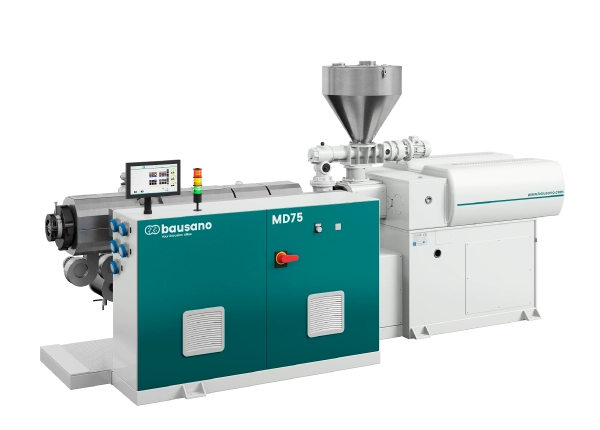
The extrusion process begins with feeding plastic material—typically in granule or powder form—into the extruder’s hopper. From there, the material enters a heated barrel where a rotating screw conveys it forward. As the material moves through the cylinder, mechanical energy and heat cause it to melt, homogenize, and compact.
The molten polymer is then pushed through a die that shapes its final form. Once extruded, the product is cooled—usually in a water bath—to stabilize its structure, then dimensionally calibrated and finally cut or rolled, depending on the end application.
Precise control over process parameters—such as temperature, screw speed, and pressure—is essential for product quality. Even minor variations can impact thickness, uniformity, and dimensional stability.
Types of Extrusion
Different extrusion setups are used to meet specific processing needs. The most common is single-screw extrusion, ideal for standard materials and basic mixing requirements. Twin-screw extrusion, on the other hand, is better suited for applications requiring enhanced homogeneity or the incorporation of additives and fillers. In this configuration, two screws—either co-rotating or counter-rotating—provide intensive mixing, making it a preferred choice for medical or high-performance compounding applications.
Co-extrusion is another variation that enables the combination of multiple materials in a single profile — for example, combining a rigid core with a flexible outer layer. Depending on the materials and application, extrusion can also be categorized into hot extrusion (typical for plastics) and cold extrusion (more common with metals). Learn more in our dedicated article.
Applications of Extrusion in Industry
Extrusion is widely used across nearly all areas of manufacturing. In the construction sector, it enables the production of PVC profiles for windows, wall cladding, and electrical conduits. In automotive, extrusion is used to create seals, technical ducts, and trim profiles.
Packaging manufacturers rely on extrusion to produce multilayer films, sheets, and bags—often using co-extrusion. In the medical field, extrusion supports the production of precision items like tubing, catheters, and single-use devices, where high performance and biocompatibility are essential.
Bausano’s extrusion technology also plays a key role in recycling, allowing post-consumer and post-industrial plastics to be transformed into new semi-finished products.
Materials Used in Extrusion
Extrusion can be applied to a wide range of polymers, each with specific characteristics. Among the most commonly used are PVC, available in both rigid and plasticized versions, ideal for producing profiles and pipes. Polyethylene, in HDPE and LDPE grades, is appreciated for its chemical resistance and versatility. Polypropylene (PP) offers good mechanical properties and is suitable for various processing applications.
Other frequently extruded materials include polystyrene (PS), copolymers such as TPU, EVA, and TPE, as well as biodegradable polymers like PLA and PHA, which are mainly used in sustainability-focused applications. The choice of material directly affects the line configuration, processing parameters, and final product performance.
Extrusion is one of the most established and strategic technologies for processing plastic materials. Its ability to ensure continuous production, application versatility, and precise control of process parameters makes it a preferred solution in many industrial contexts.
Thanks to its extensive experience and ongoing research and development efforts, Bausano offers customizable extrusion lines, designed to deliver high performance, energy efficiency, and maximum reliability, tailored to the specific needs of each sector.


 Back
Back