In Brief
Laboratory extruders enable small-scale simulation of the extrusion process for material testing and formulation development. Thanks to their precise control and versatility, they are essential for evaluating polymers, additives, and processing behavior. This article outlines their key features, applications, and advantages in R&D.
Laboratory extruders are essential tools for applied research, material validation, and the development of new plastic formulations. Used in the R&D departments of companies and research centers, they allow for scaled-down simulation of plastic behavior during the extrusion process.
Thanks to their versatility and the ability to precisely control operating parameters, benchtop extruders are a powerful solution for mixing, homogenization, polymer compatibility testing, and the evaluation of additives and fillers. This article explores the role, technical configuration, and key advantages of these systems in industrial innovation processes.
What Is a Laboratory Extruder?
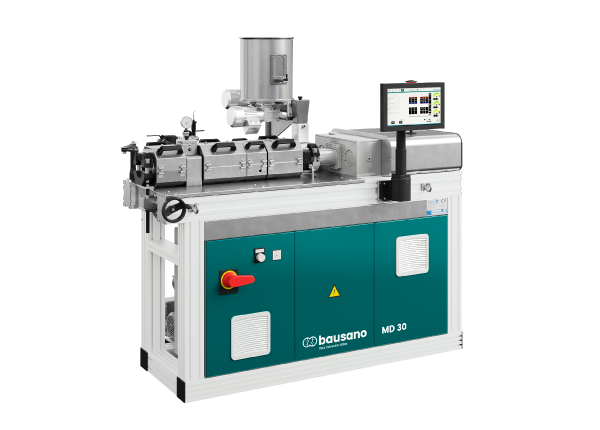
A laboratory extruder is a scaled-down machine that accurately replicates the mechanisms of a full-size industrial extruder, while operating with very small quantities of material. Despite their compact size, these machines maintain all the core functional stages: feeding, melting, mixing, conveying, and shaping through a die.
They are mainly used for laboratory testing on thermoplastics, rheological studies, experimental compounding, and process simulations during pre-industrial phases. Lab extruders can also produce micro-samples for mechanical, physical, and chemical analysis.
Main Components and Specifications
A lab extruder shares the same core components as an industrial system:
-
Feeding unit: introduces the material into the screw via a hopper, optionally using volumetric or gravimetric dosing.
-
Heated barrel and screw: responsible for melting, homogenizing, and conveying the material toward the die.
-
Extrusion head with die: defines the shape of the extrudate, such as filament, film, or specific profiles.
-
Cooling system: stabilizes the material after extrusion, essential for dimensional accuracy.
-
Control panel: allows for precise monitoring and regulation of parameters such as temperature, torque, pressure, and screw speed.
Advanced versions may include real-time data acquisition sensors, test control software for repeatability, and digital interfaces compatible with Bausano Sphera environments.
Applications in Research and Quality Control
Laboratory extruders are highly valuable in a wide range of R&D applications. In innovation labs and corporate research centers, they are used to study the behavior of new or modified plastics, to assess processability, compatibility between different polymers, and final performance.
They are ideal for developing custom compounds, formulated with specific additives, fillers, or reinforcements to meet strict technical specifications. At the same time, these machines are extremely effective in quality control workflows. Companies use them to ensure consistency across production batches or to compare virgin with recycled materials to determine industrial suitability.
They are also widely used to test biocompatible materials for medical applications, and for experimenting with sustainable solutions such as biopolymers and recycled plastics.
Advantages of Using Lab-Scale Extrusion
Employing a laboratory extruder provides several strategic benefits:
-
Lower material and energy consumption: small batches and low power usage without running full-scale lines.
-
Fast testing cycles: ideal for rapid iterations and comparing multiple formulations.
-
High experimental flexibility: easy die or screw changes and quick parameter adjustments.
-
Excellent test repeatability: advanced control systems ensure consistent results.
-
Minimal waste: ideal for costly or limited-availability materials.
From Lab to Production: Scaling Up
One of the main purposes of lab extruders is to transfer testing results to full-scale production. For effective scale-up, it’s crucial to ensure that lab conditions closely mirror those of industrial processes.
The data collected during lab trials—such as torque curves, melt temperature, and viscosity behavior—are used to size the industrial screw, define processing parameters, select feeding systems, and fine-tune the die.
This approach helps reduce plant start-up risks and shorten the time-to-market for new products.
Laboratory extruders form a vital link between concept and large-scale production. They offer a controlled environment for testing new materials, optimizing formulations, and reducing development costs and lead times.
Thanks to the specialized range of laboratory extruders developed by Bausano, manufacturers can accurately simulate real-world extrusion conditions, ensuring seamless transition from testing to production and driving innovation in plastic processing through a sustainable and forward-looking approach.


 Back
Back